Water and the scale
The whoosh effect: is it real?
A stalled scale, then a sudden drop overnight. Dieters have a name for it, and science has no study of it. Here is what the measured mechanisms say instead.

Short answers
We checked PubMed on 2 November 2026 before writing this.
Is the whoosh effect real?
The whoosh effect, a sudden overnight drop after weeks of a stalled scale, describes something many dieters see, but no study has tested it. A PubMed search for "whoosh effect" returns five papers, all about anaesthesia or motion sensors, and none about weight loss.
What probably explains it?
Water is the likely explanation for the whoosh effect. Fat loss continues under the surface while the body holds extra water for a while, then releases it. Glycogen water, salt, the menstrual cycle and the weekly eating rhythm can all mask or reveal fat loss on the scale.
Can you trigger a whoosh?
There is no evidence that a cheat meal, alcohol or any trick triggers a whoosh. A big high-carbohydrate meal refills glycogen, which binds at least 3 grams of water per gram, so the scale usually rises the next day.
What people mean by the whoosh effect
The whoosh effect is a dieting-forum name for a pattern: the scale stays flat for one to three weeks despite steady effort, then drops by a couple of pounds almost overnight. The popular explanation says emptied fat cells temporarily fill with water, then release it all at once. The pattern is common enough that dieting forums gave it a name. The explanation is untested.
We searched PubMed for the term before writing this page. The five results are about caudal anaesthesia, Doppler scanning and gait monitoring. Not one studies body weight. So anything you read about how the whoosh "works" is a hypothesis, including what follows here. The difference is that we can point to measured mechanisms that would produce the same pattern.
How water can hide fat loss for weeks
Water retention during dieting can hide fat loss on the scale, and the clearest historical evidence is extreme. In the wartime Minnesota Starvation Experiment, 36 men on semistarvation rations lost more than a quarter of their body weight and many developed swelling in their lower legs (Kalm and Semba, Journal of Nutrition, 2005). Their bodies were losing tissue and holding extra water at the same time.
Ordinary diets produce smaller versions of the same overlap. Restricting calories to 1,200 a day for three weeks increased cortisol output in a controlled trial of 121 women (Tomiyama et al., Psychosomatic Medicine, 2010). Whether that cortisol rise makes dieters hold water has not been tested directly; it is one of the more plausible links, and we flag it as unproven.
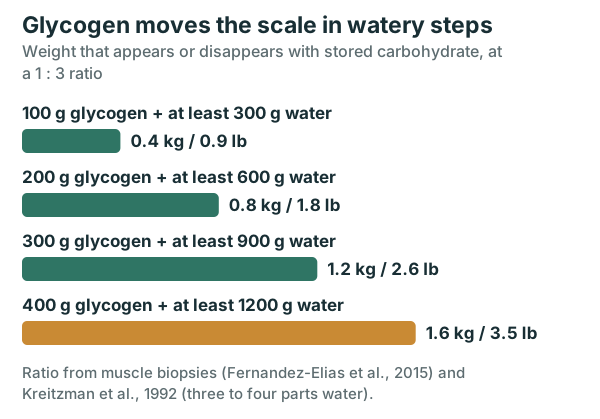
Glycogen is the mechanism with the firmest numbers. Each gram of glycogen is stored with at least 3 grams of water (Fernández-Elías et al., 2015), and Kreitzman's group wrote about "the influence of water-laden glycogen on weight fluctuations during the dieting process" in 1992. Shift a few hundred grams of glycogen and the scale moves by pounds.
Whoosh claims, checked against the evidence
Most whoosh-effect advice mixes one solid idea (water masks fat loss) with several untested ones. Here is how each common claim holds up.
| Claim | What the evidence says | Verdict |
|---|---|---|
| Emptied fat cells fill with water, then release it | No human study found. Plausible-sounding, unmeasured. | Untested |
| Water can hide fat loss for a while | Documented in semistarvation (leg swelling) and in glycogen-water shifts | Supported |
| A cheat meal or alcohol "triggers" the whoosh | No study. Extra carbohydrate refills glycogen, adding water | No evidence; often the opposite |
| Squishy or jiggly fat means a whoosh is coming | No study links how fat feels to imminent weight change | No evidence |
| Stalls before a period end with a drop | Self-reported fluid retention peaks on day one of the period, then falls (White et al., 2011) | Consistent with the data |
| Monday highs, Friday lows | Weight is highest Sunday to Monday and falls through the week (Orsama et al., 2014) | Supported |
What to do while you wait
If your weight has stalled for a week or two on a plan that was working, the evidence favours patience over changes. Keep the plan, weigh under the same conditions, and judge on weekly averages over three to four weeks, since a single period or a salty weekend can cover a short stretch. Our guide to daily weight fluctuation has a simple weighing method.

Keep showing up
Picture three weeks from now: the same runs, the same meals, and a scale that has quietly caught up with what you were doing all along. That catch-up is what most whoosh stories describe.
If the stall lasts beyond a month, stop waiting and check the numbers. Time is the cheapest test there is, but it has an end date.
Whoosh effect questions
Does fat feel squishy when you are losing weight?
Some people say fat feels softer or "squishier" while losing weight, but no study has measured this or linked it to coming weight change. For now it is an anecdote.
Why am I not losing weight on 1,200 calories?
When people do not lose weight on a reported 1,200 calories, measurement is the usual explanation. In a classic NEJM study, people in that situation had normal metabolisms, but their food records missed about 47% of what they actually ate (Lichtman et al., 1992). A short-term stall can also be water.
How long can water retention hide fat loss?
How long water can mask fat loss has not been measured in ordinary dieters. Cycle-related retention follows the menstrual cycle, and glycogen shifts settle within days. If the scale has not moved for more than a month, look for a true plateau.
Sources
PubMed searched on 2 November 2026 for "whoosh effect" (5 results, none on body weight) and "whoosh AND weight loss" (0 results).
- Kalm LM, Semba RD. They starved so that others be better fed: remembering Ancel Keys and the Minnesota experiment. J Nutr. 2005;135:1347-52. PubMed 15930436
- Tomiyama AJ, et al. Low calorie dieting increases cortisol. Psychosom Med. 2010;72:357-64. PubMed 20368473
- Fernández-Elías VE, et al. Relationship between muscle water and glycogen recovery after prolonged exercise in the heat in humans. Eur J Appl Physiol. 2015;115:1919-26. PubMed 25911631
- Kreitzman SN, Coxon AY, Szaz KF. Glycogen storage: illusions of easy weight loss, excessive weight regain, and distortions in estimates of body composition. Am J Clin Nutr. 1992;56:292S-3S. PubMed 1615908
- White CP, et al. Fluid retention over the menstrual cycle: 1-year data from the prospective ovulation cohort. Obstet Gynecol Int. 2011:138451. PubMed 21845193
- Orsama AL, et al. Weight rhythms: weight increases during weekends and decreases during weekdays. Obes Facts. 2014;7:36-47. PubMed 24504358
- Lichtman SW, et al. Discrepancy between self-reported and actual caloric intake and exercise in obese subjects. N Engl J Med. 1992;327:1893-8. PubMed 1454084
Keep reading

Fluctuation
Daily weight fluctuation
What moves the scale from morning to night and week to week, and how to read it calmly.

Plateaus
Weight loss plateaus
Why every fixed diet stops working, how to check whether yours has, and what to change first.

Metabolism
Metabolic adaptation
How much your metabolism slows after weight loss, study by study, and why starvation mode is a myth.