Plateaus
Weight loss plateau: what causes it and how to break it
Every diet that stays the same eventually stops working, for reasons that are predictable and measurable. Here is how to tell a real plateau from a noisy week, and what to change first.

Short answers
The evidence for each is in the sections below.
What is a weight loss plateau?
A weight loss plateau is a stretch of weeks when body weight stops falling even though you have not knowingly changed your eating or activity. In weight loss programs it typically appears around six to eight months in (Ashtary-Larky and Mohammadi, 2026 review).
Why do plateaus happen?
A weight loss plateau happens because the calorie gap closes from both sides: a lighter body burns less, and appetite rises by roughly 100 calories a day for each kilogram lost (Polidori et al., 2016). Eventually intake and expenditure meet. Short stalls can also be water.
How do you break a plateau?
To break a weight loss plateau, first recalculate your calorie needs at your current weight, then measure intake carefully for a week or two, then add daily movement. If none of that fits your life, a planned maintenance phase is a legitimate choice. A cheat day has no evidence behind it.
Why weight loss always slows down
Weight loss slows on any fixed diet because the deficit that produced it shrinks as you get lighter. Kevin Hall's group at the NIH modelled this in The Lancet: when you change what you eat, body weight moves toward a new steady state slowly, with a half-time of about a year (2011). The curve bends gradually and flattens. A plateau is where every unchanged diet eventually ends up.
The familiar "3,500 calories equals one pound" rule hides this. It assumes the deficit stays constant forever, so it predicts steady, straight-line loss. When Diana Thomas and colleagues compared that rule with seven tightly controlled weight loss experiments, it "grossly overestimates actual weight loss" (International Journal of Obesity, 2013). If you planned your diet with that rule, a slowdown says more about the rule than about you.
The first weeks also flatter you. Glycogen, the carbohydrate stored in muscle and liver, is held with three to four parts water, and a calorie cut draws it down early (Kreitzman et al., 1992). Part of the fast early loss is water that stops leaving once glycogen settles at a lower level. The drop from that fast start to a slower pace often feels like a plateau, even when fat loss is continuing.
The two brakes: burn and appetite
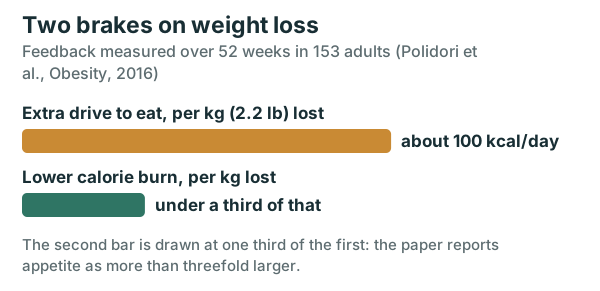
A weight loss plateau usually forms because two brakes engage at once. The smaller one is energy expenditure: a lighter body burns less, plus a modest extra drop known as metabolic adaptation. The larger one is appetite. In 153 people tracked for a year, appetite rose by about 100 calories a day for each kilogram (2.2 lb) lost, more than three times the drop in calorie burn (Polidori et al., Obesity, 2016).
Appetite drift rarely feels like overeating. Portions get a little bigger, a snack returns, the cooking oil goes in by eye. The NIH Body Weight Planner warns that "people often underestimate how much they eat", and the best-known test of that is sobering: ten adults who said they could not lose weight on under 1,200 calories were eating far more than they recorded, with normal metabolisms (Lichtman et al., NEJM, 1992).
The 2026 review by Ashtary-Larky and Mohammadi adds a detail people overlook. Of all the parts of daily energy use, the one that falls most during weight loss is often non-exercise activity: the walking, standing and fidgeting you do without thinking. Tired dieters move less, and they rarely notice.
Is it a real plateau? A quick check
A real weight loss plateau means your intake now matches your expenditure. Several other things look the same on a scale for a week or two. Before changing anything, match what you are seeing to the most likely cause.
| What you notice | Most likely cause | What to check | Evidence |
|---|---|---|---|
| Weight flat or up for a few days after a salty or carbohydrate-heavy meal, or before a period | Water retention | Compare weekly averages, not single days | NHS on fluid retention; White et al., 2011 |
| Weight is always higher on Monday | Weekend eating rhythm | Compare the same weekday week to week | Orsama et al., 2014 |
| Loss slowed gradually over months on the same plan | Smaller body, smaller deficit | Recalculate needs at today's weight | Hall et al., 2011 |
| Hungrier than at the start; portions crept up | Appetite feedback | Weigh food for one to two weeks | Polidori et al., 2016 |
| Stall plus tiredness, feeling cold, constipation | Possibly an underactive thyroid | See a doctor for a blood test | NHS |
| Stall began with a new medicine | Some medicines affect appetite or burn | Ask the prescriber; do not stop it yourself | NIDDK |
The last two rows are for a doctor, who can usually rule them in or out quickly.
Short stalls of a few days fit the first two rows best, because both causes reverse within a week or so. A flat month after a long run of steady loss is more likely to be the real thing. For a closer look at the day-to-day swings, see our guide to how much weight fluctuates in a day.
How to break a weight loss plateau
Breaking a weight loss plateau means reopening the calorie gap or deciding, on purpose, to hold your new weight for a while. These are the options in the order we would try them, with the strength of evidence for each.
- Recalculate. Your maintenance calories at today's weight are lower than when you started. Enter current numbers into the NIH Body Weight Planner and retire the old target.
- Measure for two weeks. Weigh food, count drinks and cooking fats, and log every day including weekends. Lichtman's study is the reason this step comes so early.
- Add everyday movement. Since non-exercise activity is what drops most, a walking target is a direct counterweight. We would rather see a modest daily walk than an occasional heroic session.
- Protect sleep. In a two-week trial, dieters who slept 5.5 hours lost less fat and more fat-free mass than when they slept 8.5 hours (Nedeltcheva et al., 2010).
- Take a planned maintenance phase. Eating at maintenance for a few weeks is a valid strategy, with mixed trial results; our reverse dieting and diet breaks guide walks through them.

Holding steady is a result too
Imagine the version of this where the plateau is a landing, a place to rest: the same meals you have learned to enjoy, the same walks, and a weight that stays put for a season.
Keeping weight off is the harder skill, and it gets easier with practice. People in the US National Weight Control Registry who held their loss for two to five years had much better odds of holding it longer (Wing and Phelan, 2005).
Do cheat days or refeeds break a plateau?
A cheat day does not break a weight loss plateau according to any trial we could find. The idea is that one big day "resets" metabolism. What the controlled studies actually tested were extended periods at maintenance: in the MATADOR trial, two full weeks of eating to maintenance between dieting blocks (Byrne et al., 2018). One day of feasting refills glycogen, and with it water, so the scale usually goes up the next morning.
If a planned higher-calorie day helps you stick to a plan, that is a reasonable personal choice. Just do not expect it to change your physiology.
Plateau questions
How long does a weight loss plateau last?
A true weight loss plateau lasts until intake or activity changes, because it means calories in and out have met. There is no good data on a typical duration. Water-driven stalls end when the cause does: a salty meal passes, a period ends, glycogen settles back after a big carbohydrate day.
I'm stuck at the same weight for weeks. What should I do?
If you have been stuck at one weight for weeks, the calorie cut that worked at a higher weight now leaves a smaller deficit. Recalculate your needs at the current weight, weigh food for two weeks, and add daily walking before cutting calories further.
Can a cheat day break a weight loss plateau?
No trial shows that a single cheat day breaks a weight loss plateau. Studies of diet breaks used weeks at maintenance, not one day of overeating, and one large day mostly adds glycogen and water to the scale.
Is a plateau a sign that my metabolism is damaged?
A weight loss plateau is not evidence of metabolic damage. In most dieters the extra slowing at rest is small, about 50 to 100 calories a day, and it fades once weight is stable (Martins et al., 2020). Appetite and a smaller body explain most of it.
Should I eat less to get past a plateau?
Eating less is one way past a plateau, but cutting deeper increases hunger, and CDC guidance notes that people who lose weight gradually, about 1 to 2 pounds a week, are more likely to keep it off. Check measurement and movement first.
Sources
Every figure on this page comes from the source named next to it. We read the abstract or full page of each one.
- Ashtary-Larky D, Mohammadi S. Weight loss plateau: reasons, challenges, and solutions. A narrative review. Health Sci Rep. 2026;9(7):e72803. PubMed 42466371
- Hall KD, et al. Quantification of the effect of energy imbalance on bodyweight. Lancet. 2011;378:826-37. PubMed 21872751
- Thomas DM, et al. Can a weight loss of one pound a week be achieved with a 3500-kcal deficit? Int J Obes. 2013;37:1611-3. PubMed 23628852
- Kreitzman SN, Coxon AY, Szaz KF. Glycogen storage: illusions of easy weight loss, excessive weight regain, and distortions in estimates of body composition. Am J Clin Nutr. 1992;56:292S-3S. PubMed 1615908
- Polidori D, et al. How strongly does appetite counter weight loss? Obesity. 2016;24:2289-95. PubMed 27804272
- Lichtman SW, et al. Discrepancy between self-reported and actual caloric intake and exercise in obese subjects. N Engl J Med. 1992;327:1893-8. PubMed 1454084
- Orsama AL, et al. Weight rhythms: weight increases during weekends and decreases during weekdays. Obes Facts. 2014;7:36-47. PubMed 24504358
- White CP, et al. Fluid retention over the menstrual cycle: 1-year data from the prospective ovulation cohort. Obstet Gynecol Int. 2011:138451. PubMed 21845193
- Nedeltcheva AV, et al. Insufficient sleep undermines dietary efforts to reduce adiposity. Ann Intern Med. 2010;153:435-41. PubMed 20921542
- Byrne NM, et al. Intermittent energy restriction improves weight loss efficiency in obese men: the MATADOR study. Int J Obes. 2018;42:129-38. PubMed 28925405
- Martins C, et al. Metabolic adaptation is an illusion, only present when participants are in negative energy balance. Am J Clin Nutr. 2020;112:1212-8. PubMed 32844188
- Wing RR, Phelan S. Long-term weight loss maintenance. Am J Clin Nutr. 2005;82(1 Suppl):222S-5S. PubMed 16002825
- NIDDK. Body Weight Planner. niddk.nih.gov/bwp
- NIDDK. Factors affecting weight and health. niddk.nih.gov
- NHS. Underactive thyroid (hypothyroidism). nhs.uk
- NHS. Swollen ankles, feet and legs (oedema). nhs.uk
- CDC. Steps for losing weight. cdc.gov
Keep reading

Metabolism
Metabolic adaptation
How much your metabolism slows after weight loss, study by study, and why starvation mode is a myth.

Fluctuation
Daily weight fluctuation
What moves the scale from morning to night and week to week, and how to read it calmly.

After the diet
Reverse dieting and diet breaks
One trial on reverse dieting, several on diet breaks, and what they mean for ending a diet well.