Set point
Set point theory: does your body defend a weight?
The body clearly pushes back when weight falls. Whether it aims at one fixed number is another question, and the research has moved on to more useful models.

Short answers
The studies behind each answer are below.
What is set point theory?
Set point theory says the brain holds a target level of body fat and adjusts hunger and energy use to defend it, like a thermostat. When you lose weight, appetite rises and calorie burn falls; when you gain, the opposite happens.
Has set point theory been proven?
Set point theory is only partly supported. The body clearly defends against weight loss (Leibel et al., 1995; Sumithran et al., 2011), but a fixed set point cannot explain why average weight rose so fast in many countries since the 1980s (Speakman et al., 2011). Most researchers now favour hybrid models.
Can you change your set point weight?
No study has shown a reliable way to reset a set point weight. The evidence suggests the weight you settle at shifts with your environment and habits, and that defence against loss stays strong for at least a year after dieting.
The idea in one paragraph
Set point theory treats body fat like room temperature: the brain has a target, measures the current level through signals such as leptin (a hormone made by fat tissue), and corrects any drift by changing appetite and energy use. Michael Rosenbaum and Rudolph Leibel summarised the case in 2010: after otherwise successful weight loss, over 80 percent of people return to their previous fatness, which they attribute to coordinated metabolic, hormonal and behavioural responses defending a brain-defined "ideal" (International Journal of Obesity).
The theory makes a testable prediction: push weight down and the body pushes back; push it up and the body pushes back too. Both halves have been tested.
The evidence for a set point
The strongest evidence for a set point is that the body responds to weight change in both directions. In Leibel's inpatient study at Rockefeller University, holding people 10 percent above their usual weight raised total energy expenditure by 8 to 9 calories per kilogram of fat-free mass per day, and holding them 10 percent or more below lowered it by 6 to 8 (NEJM, 1995). The response did not depend on how much fat people had to begin with.
The defence of weight loss also shows up in hormones and lasts. In a Melbourne-led trial, 50 people lost an average of 13.5 kg on a 10-week very low energy diet. A year later, leptin, peptide YY and several other signals still sat at levels that favour eating, ghrelin was still higher, and hunger was still up (Sumithran et al., NEJM, 2011).
Weight gain meets resistance too, through a route most people never think about. When James Levine's team at the Mayo Clinic overfed 16 non-obese volunteers by 1,000 calories a day for eight weeks, two thirds of the extra energy burned came from non-exercise activity: fidgeting, posture, moving around. People who ramped that activity up most stored the least fat, and fat storage differed tenfold between them (Science, 1999).
Where set point theory falls short
Set point theory struggles with one fact above all: average body weight in many countries rose sharply from the 1980s. A thermostat that defended a fixed target would have resisted that. John Speakman and 24 co-authors made this point in Disease Models and Mechanisms in 2011, noting that the set point model "struggles to explain the many significant environmental and social influences on obesity".
The regulation also looks lopsided. Manfred Müller, Anja Bosy-Westphal and Steven Heymsfield described weight regulation as "more effective in response to weight loss than to weight gain", and argued that in a world of abundant food a fixed set point is effectively replaced by "settling points" shaped by what and how much people eat (F1000 Medicine Reports, 2010).
Set point, settling point and the models in between
Researchers now describe body weight regulation with several competing models, and the most useful ones combine biology with environment. This table follows the review by Speakman and colleagues.
| Model | Core idea | Explains well | Struggles with |
|---|---|---|---|
| Set point | Active feedback from fat stores to intake and energy use, around a target encoded in the brain | Defence against loss; hormone changes; genetic effects | Rising average weight since the 1980s; social and environmental effects |
| Settling point | Passive feedback: weight settles wherever intake and expenditure balance in a given environment | Environmental and social influences; population weight gain | Biological and genetic findings |
| General intake model | Many factors push intake up or down; some are compensated, some are not | Why a lasting change in environment produces a lasting change in weight, scaled by inherited responsiveness | Focuses on intake and treats expenditure as a side factor |
| Dual intervention point | Strong regulation only below a lower limit and above an upper limit; weak or none in between | Why loss is defended harder than gain; why people differ in gain | Where the limits sit, and what sets them, is unclear |
Speakman's group gives the dual intervention point model an evolutionary rationale: the lower limit set by the risk of starvation, the upper limit by the risk of predation.
In plain terms, the dual intervention point model says there may be a comfortable range rather than a single number. Inside it, weight drifts with habits and surroundings. Fall below its floor and the body fights hard; rise toward its ceiling and some people fight back far better than others.

Your starting point was partly inherited
Think of the meals you grew up with and the bodies around that table. Genes and family habits both set the range your weight drifts in, which is why two people on the same plan can see very different results.
That is not fate. The range responds to surroundings, and surroundings are something you can change at home.
Can you change your set point weight?
There is no tested method for changing a set point weight, and claims of a quick "reset" should be read with that in mind. What the evidence does show is more modest. The weight you settle at moves with diet and activity, according to the settling point and general intake models. And the defence against a lower weight persists: in Rosenbaum's 2008 study, people who had held a 10 percent loss for over a year burned less than expected by as much as people who had just finished dieting.
There is an encouraging signal from people who keep weight off. In the US National Weight Control Registry, those who had maintained their loss for two to five years had a much better chance of holding it longer (Wing and Phelan, 2005). Whether that reflects biology settling, habits becoming automatic, or both, nobody has separated yet.
Set point questions
How do you reset your body's set point?
No study has found a way to reset the body's set point. The settling point view suggests changing the environment that weight settles in: food at home, routine activity, sleep. Defence against weight loss can persist for more than a year.
What is the difference between set point and settling point?
A set point is an active target the brain defends. A settling point is passive: weight settles where intake and expenditure happen to balance in your current environment, and moves when the environment does.
Why did I gain 10 pounds but look the same?
Ten pounds spread over a whole adult body changes each area only slightly, and part of a quick gain is often water and glycogen. Waist measurements and how clothes fit track fat change better than the scale over short periods.
Is set point weight genetic?
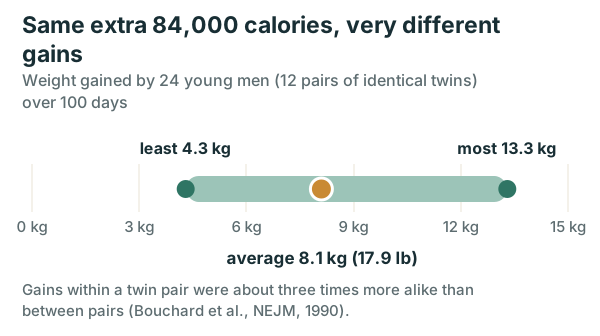
Set point weight is partly genetic. In the twin overfeeding study, identical twins responded alike, with about three times more variation between pairs than within them (Bouchard et al., 1990). Environment still decides much of where weight settles.
Sources
We read the abstracts of all studies below, and the full text of the Speakman review for the model descriptions.
- Rosenbaum M, Leibel RL. Adaptive thermogenesis in humans. Int J Obes. 2010;34 Suppl 1:S47-55. PubMed 20935667
- Leibel RL, Rosenbaum M, Hirsch J. Changes in energy expenditure resulting from altered body weight. N Engl J Med. 1995;332:621-8. PubMed 7632212
- Sumithran P, et al. Long-term persistence of hormonal adaptations to weight loss. N Engl J Med. 2011;365:1597-604. PubMed 22029981
- Levine JA, Eberhardt NL, Jensen MD. Role of nonexercise activity thermogenesis in resistance to fat gain in humans. Science. 1999;283:212-4. PubMed 9880251
- Bouchard C, et al. The response to long-term overfeeding in identical twins. N Engl J Med. 1990;322:1477-82. PubMed 2336074
- Speakman JR, et al. Set points, settling points and some alternative models. Dis Model Mech. 2011;4:733-45. PubMed 22065844
- Müller MJ, Bosy-Westphal A, Heymsfield SB. Is there evidence for a set point that regulates human body weight? F1000 Med Rep. 2010;2:59. PubMed 21173874
- Rosenbaum M, et al. Long-term persistence of adaptive thermogenesis in subjects who have maintained a reduced body weight. Am J Clin Nutr. 2008;88:906-12. PubMed 18842775
- Wing RR, Phelan S. Long-term weight loss maintenance. Am J Clin Nutr. 2005;82(1 Suppl):222S-5S. PubMed 16002825
Keep reading

Metabolism
Metabolic adaptation
How much your metabolism slows after weight loss, study by study, and why starvation mode is a myth.

After the diet
Reverse dieting and diet breaks
One trial on reverse dieting, several on diet breaks, and what they mean for ending a diet well.

Plateaus
Weight loss plateaus
Why every fixed diet stops working, how to check whether yours has, and what to change first.