Metabolism
Metabolic adaptation: what the studies actually measured
Your body does burn less after weight loss, partly beyond what a smaller body explains. How much depends on who was studied, and on whether they were still dieting when measured.

Short answers
Each answer is expanded below, with the study behind it.
What is metabolic adaptation?
Metabolic adaptation (researchers also call it adaptive thermogenesis) is the part of the drop in calorie burn after weight loss that the smaller body does not explain. It is calculated as measured energy expenditure minus the value predicted from your new weight and body composition.
How big is it?
For ordinary dieters, metabolic adaptation at rest is usually small: about 50 to 100 calories a day at the end of a diet, shrinking toward zero once weight is stable (Martins et al., 2020). Extreme loss is different: Biggest Loser contestants were still about 500 calories a day below prediction six years later.
Is starvation mode real?
Starvation mode, in the sense of the body halting fat loss while you eat in a real deficit, is not supported by the evidence. Men in the 1940s Minnesota semistarvation experiment mostly lost more than a quarter of their body weight. Adaptation slows loss down; it does not stop or reverse it.
Does it explain weight regain?
Metabolic adaptation measured at the end of a diet did not predict who regained weight in the Biggest Loser follow-up or in two separate 2020 trials. Appetite looks like the bigger force: roughly 100 extra calories a day of drive to eat for every kilogram lost (Polidori et al., 2016).
What metabolic adaptation means, in numbers
Metabolic adaptation is the gap between how many calories your body burns after weight loss and how many it should burn at its new size. Some drop is simply arithmetic: a body that weighs 20 pounds less has less tissue to fuel and less mass to carry around, so it needs fewer calories. Nobody calls that adaptation. The term covers only the extra drop on top of it.
To measure metabolic adaptation, researchers put people in a respiration chamber or use indirect calorimetry to get their actual burn, scan their body composition, and compare the result with an equation built from people of the same size who never dieted. A negative residual is the adaptation. That method matters, because it explains why headlines swing between "your metabolism is broken" and "metabolic adaptation is a myth".
Here is the short version of the physiology. Rudolph Leibel's group at Rockefeller University held 41 volunteers at 10 to 20 percent below their usual weight and found that total energy expenditure fell by 6 to 8 calories per kilogram of fat-free mass per day more than body size predicted (NEJM, 1995). Resting and non-resting expenditure each accounted for about half of that. For a person carrying 55 kg of fat-free mass, the total works out to very roughly 330 to 440 calories a day.
Why the studies seem to disagree
Metabolic adaptation estimates range from almost nothing to 500 calories a day because the studies measure different things, in different people, at different moments. Three variables do most of the work: whether people were still losing weight when measured, whether only resting metabolism was measured, and how extreme the weight loss was.
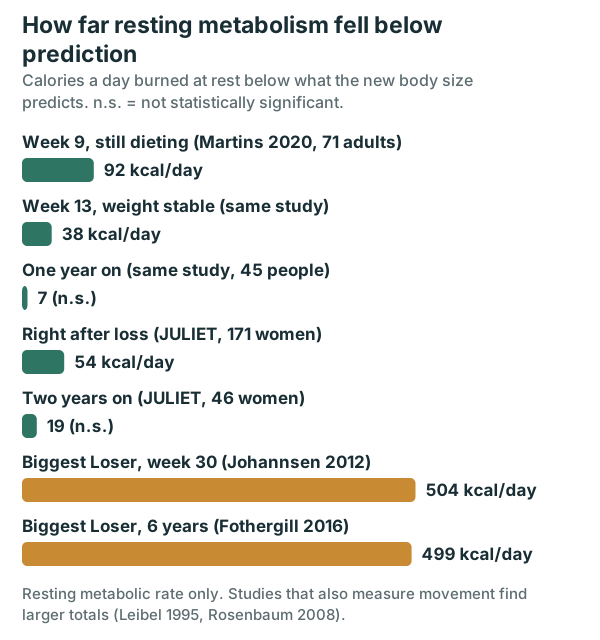
The energy-balance effect is the one most people miss. Catia Martins and colleagues put 71 adults with obesity on a 1,000-calorie diet for eight weeks. Resting metabolic adaptation was 92 calories a day at week 9, while they were still in deficit. After four weeks of eating enough to hold their weight steady, it had halved to 38. In the subgroup measured again a year later it was 7 calories a day, statistically indistinguishable from zero (American Journal of Clinical Nutrition, 2020).
The Biggest Loser study sits at the other end. Kevin Hall's NIH team followed 14 contestants who lost an average of 58 kg (128 lb) in 30 weeks through severe calorie restriction and vigorous exercise. Six years later they had regained 41 kg on average, yet their resting metabolism was still 499 calories a day below what their size predicted. The ones who kept the most weight off had the largest gap. Hall's reading: adaptation is "a proportional, but incomplete, response" to the ongoing effort of holding weight down.
| Study | Who | What was measured | What they found |
|---|---|---|---|
| Leibel et al., NEJM 1995 | 41 adults held 10 to 20% below usual weight | Total, resting and non-resting expenditure | Total burn 6 to 8 kcal per kg fat-free mass per day below prediction |
| Rosenbaum et al., AJCN 2008 | 7 matched trios, some holding a 10% loss for over a year | Total and resting expenditure on a fixed formula diet | The lower burn was just as large after more than a year as after 5 to 8 weeks |
| Johannsen et al., JCEM 2012 | 16 Biggest Loser contestants | Resting metabolism, week 30 | 504 kcal/day below prediction despite keeping most fat-free mass |
| Fothergill et al., Obesity 2016 | 14 of the same contestants | Resting metabolism, 6 years | 499 kcal/day below prediction; adaptation at week 30 did not predict regain |
| Martins et al., AJCN 2020 | 71 adults on 1,000 kcal/day | Resting metabolism at 9 weeks, 13 weeks, 1 year | 92, then 38, then 7 kcal/day; no link with regain |
| Martins et al., AJCN 2020 (JULIET) | 171 women, measured after 4 weeks of stable weight | Resting metabolism after loss, 1 and 2 years | 54 kcal/day after loss; not significant at 1 or 2 years |
Resting-only studies tend to report smaller numbers than studies that also capture the energy cost of movement.
What reconciles these results? Leibel's and Rosenbaum's work suggests a large share of the adaptation happens in movement: after weight loss, muscles do the same work for fewer calories. Studies that measure only resting metabolism, in people who have just stopped dieting, will miss that share. So "small at rest, after stabilising" and "a few hundred calories in total, in people holding a big loss" can both be true.
Starvation mode: what the evidence actually shows
Starvation mode, the idea that eating too little makes the body stop losing fat, does not hold up against the data. The clearest test is the Minnesota Starvation Experiment run by Ancel Keys during the Second World War: 36 conscientious objectors lived on semistarvation rations for months, and most lost more than 25 percent of their body weight (Kalm and Semba, Journal of Nutrition, 2005). Their bodies slowed down and they felt terrible, but they kept losing.
So where does the feeling of starvation mode come from? Often from measurement. In a well-known NEJM study, Steven Lichtman and colleagues took ten people who said they could not lose weight on under 1,200 calories a day and measured them properly for two weeks. Their metabolism was within 5 percent of normal. They had under-reported what they ate by 47 percent and over-reported their exercise by 51 percent (1992). That is a finding about how hard it is to estimate food and activity; it says nothing about honesty.
Appetite is the bigger brake
Appetite, more than metabolism, is what pushes back hardest after weight loss. David Polidori and Kevin Hall used a drug that makes people lose calories in urine without noticing, so the deficit was hidden from them, and tracked 153 people for a year. For every kilogram lost, appetite rose by about 100 calories a day: more than three times the size of the drop in calorie burn (Obesity, 2016).
The hormones agree. Priya Sumithran's team put 50 people on a 10-week very low calorie diet; they lost 13.5 kg on average. A year later, leptin (which signals fat stores) was still lower and ghrelin (which signals hunger) still higher than before the diet, and people reported feeling hungrier (NEJM, 2011). The body defends its weight mostly by making you want to eat.

Your body is doing its job
Picture the evening, a few months in, when dinner feels like a negotiation: you planned a sensible meal, and your appetite argues for a second plate. That pull is the most measurable part of metabolic adaptation. Knowing it is coming makes it easier to plan for.
Meals that fill you up for fewer calories, enough protein, and a routine that does not depend on willpower at 9 pm all work on the brake that matters most.
Can you reduce metabolic adaptation?
No diet strategy has been shown to remove metabolic adaptation, but a few change how much of it you feel. The evidence is mixed, and it is worth being precise about who was studied.
- Diet breaks helped in one trial and not in another. In MATADOR, men with obesity who alternated two weeks of dieting with two weeks at maintenance lost more weight (14.1 vs 9.1 kg) and showed less adaptation at rest than men who dieted continuously (Byrne et al., 2018). In resistance-trained adults, the ICECAP trial found no difference in fat loss, though breaks lowered hunger (Peos et al., 2021).
- Sleep changes what you lose. When ten dieters slept 5.5 hours instead of 8.5 for two weeks, the share of weight lost as fat fell by 55 percent and the loss of fat-free mass rose by 60 percent (Nedeltcheva et al., 2010).
- Exercise keeps muscle; it did not prevent the Biggest Loser contestants' adaptation. Its strongest case is for keeping weight off: members of the US National Weight Control Registry, who have kept off an average of 33 kg for more than five years, report about an hour of activity a day (Wing and Phelan, 2005).
Our read of the evidence: treat breaks and good sleep as ways to make a long diet easier to sustain. Do not expect them to switch adaptation off. Our reverse dieting guide covers the trials in more detail.
What this means if your weight loss has slowed
A slowdown after a few months of weight loss is expected, and metabolic adaptation is only one part of it. Most of the slowdown comes from simple arithmetic: a lighter body burns less, so the same intake now produces a smaller deficit. The NIH's free Body Weight Planner models this and is a better guide than any fixed rule.
Practical order of checks: first, re-estimate your needs at your current weight. Second, check intake honestly for a week (weighed portions, drinks and oils included). Third, look at sleep. Only then consider a planned maintenance phase. If you are losing weight without trying, or gaining despite eating little and feeling unwell, that is a reason to see a doctor, not a question of metabolic adaptation.
More questions about metabolic adaptation
Does metabolic adaptation go away?
Metabolic adaptation at rest largely fades once weight has been stable for a while: in two 2020 trials it was no longer statistically significant at one and two years. People who maintain a large loss can still burn less in total, mostly during movement (Rosenbaum et al., 2008).
Is "metabolic damage" real?
"Metabolic damage" is a fitness-forum term; none of the studies we reviewed uses it. No study shows permanent harm to metabolism from ordinary dieting. What is documented is an adaptation that tracks how hard the body is being held below its previous weight.
Does exercise prevent metabolic adaptation?
Exercise did not prevent it in the Biggest Loser study: contestants kept most of their fat-free mass, yet resting metabolism was 504 calories a day below prediction at week 30 (Johannsen et al., 2012). Exercise still helps you keep weight off and keeps muscle.
Can I measure my own metabolic adaptation?
Not at home. Measuring metabolic adaptation needs indirect calorimetry and a body composition scan. The practical signal is simpler: an intake that used to produce loss now holds your weight steady. Re-estimate your needs and check intake before assuming anything else.
Sources
We read the full abstract of every study listed, and the numbers above are taken from them. Links go to PubMed records or the official page.
- Leibel RL, Rosenbaum M, Hirsch J. Changes in energy expenditure resulting from altered body weight. N Engl J Med. 1995;332:621-8. PubMed 7632212
- Rosenbaum M, Hirsch J, Gallagher DA, Leibel RL. Long-term persistence of adaptive thermogenesis in subjects who have maintained a reduced body weight. Am J Clin Nutr. 2008;88:906-12. PubMed 18842775
- Johannsen DL, et al. Metabolic slowing with massive weight loss despite preservation of fat-free mass. J Clin Endocrinol Metab. 2012;97:2489-96. PubMed 22535969
- Fothergill E, et al. Persistent metabolic adaptation 6 years after "The Biggest Loser" competition. Obesity. 2016;24:1612-9. PubMed 27136388
- Martins C, et al. Metabolic adaptation is an illusion, only present when participants are in negative energy balance. Am J Clin Nutr. 2020;112:1212-8. PubMed 32844188
- Martins C, et al. Metabolic adaptation is not a major barrier to weight-loss maintenance. Am J Clin Nutr. 2020;112:558-65. PubMed 32386226
- Kalm LM, Semba RD. They starved so that others be better fed: remembering Ancel Keys and the Minnesota experiment. J Nutr. 2005;135:1347-52. PubMed 15930436
- Lichtman SW, et al. Discrepancy between self-reported and actual caloric intake and exercise in obese subjects. N Engl J Med. 1992;327:1893-8. PubMed 1454084
- Polidori D, Sanghvi A, Seeley RJ, Hall KD. How strongly does appetite counter weight loss? Obesity. 2016;24:2289-95. PubMed 27804272
- Sumithran P, et al. Long-term persistence of hormonal adaptations to weight loss. N Engl J Med. 2011;365:1597-604. PubMed 22029981
- Byrne NM, et al. Intermittent energy restriction improves weight loss efficiency in obese men: the MATADOR study. Int J Obes. 2018;42:129-38. PubMed 28925405
- Peos JJ, et al. Continuous versus intermittent dieting for fat loss and fat-free mass retention in resistance-trained adults: the ICECAP trial. Med Sci Sports Exerc. 2021. PubMed 33587549
- Nedeltcheva AV, et al. Insufficient sleep undermines dietary efforts to reduce adiposity. Ann Intern Med. 2010;153:435-41. PubMed 20921542
- Wing RR, Phelan S. Long-term weight loss maintenance. Am J Clin Nutr. 2005;82(1 Suppl):222S-5S. PubMed 16002825
- NIDDK, National Institutes of Health. Body Weight Planner. niddk.nih.gov/bwp
Keep reading
Plateaus
Weight loss plateaus
Why every fixed diet stops working, how to check whether yours has, and what to change first.

Set point
Set point theory
Does the body defend one weight? The evidence for and against, and the models that replaced it.

After the diet
Reverse dieting and diet breaks
One trial on reverse dieting, several on diet breaks, and what they mean for ending a diet well.