Fluctuation
How much does weight fluctuate in a day?
The scale weighs your breakfast, your water and your stored carbohydrate along with you. Here is what moves it, by how much, and how to read it without second-guessing every morning.

Short answers
Details and sources follow below.
How much does weight fluctuate in a day?
Body weight can fluctuate by a few pounds within a day, mostly because of the food and fluid passing through you. If you drink two litres over a day, that alone is 2 kg (4.4 lb) moving in and out. Weight is usually lowest in the morning, after the toilet and before eating.
Is day-to-day fluctuation normal?
Day-to-day weight fluctuation is normal and mostly water. In 1,421 adults weighing at home, weight rose at weekends and fell on weekdays by about 0.35% of body weight (Turicchi et al., 2020), about 0.6 lb for a 176 lb person.
What is the best way to read the scale?
The most reliable way to read the scale is to weigh at the same time under the same conditions, average each week, and compare averages. Compare Monday with Monday, since weight runs higher early in the week (Orsama et al., 2014).
What moves the scale from day to day
Daily weight fluctuation comes almost entirely from water and the contents of your gut; body fat changes far more slowly. A scale measures everything at once: tissue, the meal you ate two hours ago, the water held with stored carbohydrate, and what your kidneys have not yet excreted. Fat changes slowly; the rest can swing quickly.
| Cause | How it shows on the scale | Direction and timing | Source |
|---|---|---|---|
| Food and drink not yet digested or excreted | Adds its own mass: 1 litre of water weighs 1 kg | Rises through the day, falls overnight | Basic mass balance |
| Glycogen and the water stored with it | At least 3 g of water per gram of glycogen | Up after high-carbohydrate days, down in the first days of a diet | Fernández-Elías et al., 2015; Kreitzman et al., 1992 |
| Salty meals | The body holds extra fluid | Up for a day or two | NHS (oedema causes) |
| Menstrual cycle | Reported fluid retention peaks on the first day of a period | Lowest in the week after a period ends | White et al., 2011 |
| Weekend rhythm | Higher on Sunday and Monday | Rises from Saturday, falls from Tuesday | Orsama et al., 2014 |
| Some medicines | Fluid retention as a side effect | Steady or rising; ask the prescriber | NHS lists blood pressure drugs, the pill, hormone therapy, antidepressants, steroids |
Fluid retention by cycle day was self-reported in a diary, not weighed; it is still the best long-run data we found.
Glycogen deserves the most attention because it surprises people the most. Glycogen is the carbohydrate stored in muscle and liver, and it is bound to water. A muscle biopsy study confirmed the long-quoted ratio: each gram of glycogen came with at least 3 grams of water (Fernández-Elías et al., 2015). A pasta-heavy weekend can therefore add pounds that contain no fat at all.
How much fluctuation is normal?
Normal weight fluctuation depends on your size and routine, but two large datasets give useful anchors. Orsama and colleagues analysed 4,657 home weigh-ins from 80 adults and found a clear weekly pattern: weight peaked on Sunday and Monday and drifted down through the week (Obesity Facts, 2014). People who lost or maintained weight showed the strongest weekday "compensation".
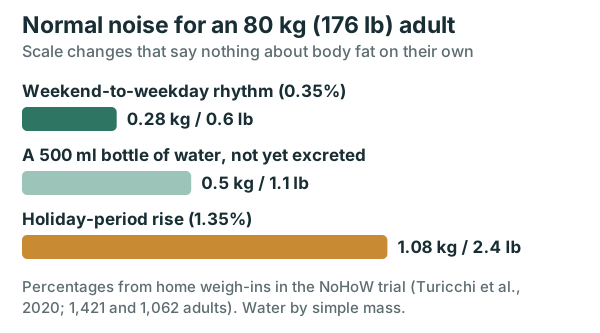
The European NoHoW trial put numbers on it: weekly swings of about 0.35% of body weight across 1,421 people, and a Christmas rise of 1.35% that was not fully reversed in the following months (Turicchi et al., PLoS One, 2020). That second finding matters more than the first. A holiday bump is normal; whether it comes back off is the part worth watching.
Why you weigh more at night
You weigh more at night than in the morning because the day's food and drink are still inside you. Overnight you keep breathing out water vapour and sweating, and the morning bathroom trip removes more, so the morning reading is the lowest and most repeatable. Weighing at night is fine, as long as you always do it at night and never compare an evening number with a morning one.
Weight fluctuation during your period
Weight fluctuation around a period is driven by fluid, and the timing is predictable. In a year-long diary study of 62 women and 765 cycles, self-reported fluid retention was lowest in the week after a period ended, rose gradually around ovulation, and peaked on the first day of menstrual flow (White et al., 2011). Bloating is also one of the most common premenstrual symptoms listed by the NHS.
The practical fix is to compare like with like: the same cycle day this month and last month, or average over a whole cycle. A rise in the days before a period is not a reason to cut calories.

Watch the trend, let the day go
Picture next Monday's weigh-in reading higher than Friday's, and you simply note it, finish your coffee, and get on with the day. That calm is the whole point of a weekly average.
If weighing yourself makes you anxious or pushes you to restrict food, it is fine to stop. Many people track progress by how clothes fit or by energy levels instead.
A weighing method that cuts the noise
A simple weighing method removes most of the daily noise. Members of the US National Weight Control Registry, who kept off large losses for years, list regular self-weighing among their habits (Wing and Phelan, 2005). The method below is how we would set it up.
- Weigh in the morning, after the toilet, before eating or drinking, in similar clothing.
- Use the same scale on the same hard floor.
- Average each week's readings, and compare this week's average with last week's.
- When you compare single days, compare the same weekday.
- Judge any diet change on a three to four week trend, longer if a period or holiday falls inside it.
When a change on the scale needs a doctor
A sudden weight gain with swelling belongs with a doctor. The NHS advises calling emergency services for swelling with shortness of breath, chest tightness or pain, or coughing up blood, and asking for an urgent appointment if one leg is swollen without a known cause. Unexplained weight loss you did not try for also deserves a doctor's look. If thoughts about food or weight feel out of control, the National Institute of Mental Health has a clear overview of eating disorders and where to find help.
Fluctuation questions
Is it normal to be 5 pounds heavier at the end of the day?
Being several pounds heavier at the end of the day can be normal, because the scale includes the day's food and drink. Two litres of fluid alone weigh 4.4 lb. Compare morning weights only, and talk to a doctor if the evening gain comes with swelling or breathlessness.
Is it normal to gain 2 lbs by the end of the day?
A 2 lb rise from morning to evening is ordinary for most adults: a meal and a few drinks weigh about that much before they are digested and excreted. It is not fat, and it should be gone by the next morning.
Why did my weight go up 3 lbs in one day?
A 3 lb jump in one day is almost always water and gut contents. Refilling 300 g of glycogen after a carbohydrate-heavy day brings at least 900 g of water with it, about 2.6 lb in total. Salty food and constipation add more. Gaining that much fat in a day would take an enormous calorie surplus.
Is it normal to fluctuate 10 pounds in a day?
A 10 lb swing within one day is far larger than the rhythms seen in home-weighing studies, where the weekly swing averaged about 0.35% of body weight. Heavy sweating or a very large meal can move a lot of water, but swings that size without an obvious reason, or with swelling, need a doctor.
Why does my weight fluctuate so much while dieting?
Weight fluctuates more while dieting because glycogen and its water shift every time carbohydrate intake changes, and because salt intake and meal timing tend to change along with the diet. Weekly averages smooth this out.
How often should I weigh myself?
How often to weigh yourself is a personal choice. Daily weighing gives the best average, and regular self-weighing is a common habit of people who keep weight off (Wing and Phelan, 2005). Weekly is fine if daily numbers bother you.
Sources
We read the abstract or full text of every source here. The NHS and NIMH pages were checked on 2 November 2026.
- Orsama AL, et al. Weight rhythms: weight increases during weekends and decreases during weekdays. Obes Facts. 2014;7:36-47. PubMed 24504358
- Turicchi J, et al. Weekly, seasonal and holiday body weight fluctuation patterns among individuals engaged in a European multi-centre behavioural weight loss maintenance intervention. PLoS One. 2020;15:e0232152. PubMed 32353079
- Fernández-Elías VE, et al. Relationship between muscle water and glycogen recovery after prolonged exercise in the heat in humans. Eur J Appl Physiol. 2015;115:1919-26. PubMed 25911631
- Kreitzman SN, Coxon AY, Szaz KF. Glycogen storage: illusions of easy weight loss, excessive weight regain, and distortions in estimates of body composition. Am J Clin Nutr. 1992;56:292S-3S. PubMed 1615908
- White CP, et al. Fluid retention over the menstrual cycle: 1-year data from the prospective ovulation cohort. Obstet Gynecol Int. 2011:138451. PubMed 21845193
- Wing RR, Phelan S. Long-term weight loss maintenance. Am J Clin Nutr. 2005;82(1 Suppl):222S-5S. PubMed 16002825
- NHS. Swollen ankles, feet and legs (oedema). nhs.uk
- NHS. PMS (premenstrual syndrome). nhs.uk
- National Institute of Mental Health. Eating disorders. nimh.nih.gov
Keep reading

Water and the scale
The whoosh effect
A stall, then a sudden drop. What is known, what is myth, and why water is the likely answer.

Plateaus
Weight loss plateaus
Why every fixed diet stops working, how to check whether yours has, and what to change first.

Start here
Why am I not losing weight?
Seven reasons the scale stalls, in the order to check them, with the evidence for each.