After the diet
Reverse dieting: what the trials show
Raising calories slowly after a diet sounds sensible, and coaches swear by it. One randomised trial has tested it. Diet breaks, its close relative, have far better evidence.

Short answers
Four trials and one meta-analysis, summarised.
What is reverse dieting?
Reverse dieting is a post-diet strategy where you raise calories in small steps, often weekly, until you reach maintenance, with the aim of limiting regain. It is popular with coaches, and we found only one randomised trial of it.
Does reverse dieting work?
In the only randomised trial, reverse dieting did not reduce weight regain. After a 5% diet, people regained 3.7% of body weight with reverse dieting, 2.7% going straight to maintenance and 1.3% eating freely, and the differences were not statistically significant (Da Silva et al., 2025).
Are diet breaks better supported?
Diet breaks have better evidence than reverse dieting. A 2025 meta-analysis of 12 randomised trials found the same fat loss with or without breaks, but a smaller drop in resting metabolism when breaks were included (Poon et al., Nutrition Reviews).
What reverse dieting is supposed to do
Reverse dieting aims to bring you back from a calorie deficit to maintenance slowly, so that your body "adjusts" and you regain less. A typical plan adds a fixed percentage of calories each week. Some promoters go further and claim it raises metabolism above where it was. That second claim is the one with the least support.
The appeal makes sense. After weeks of dieting, jumping straight back to normal eating feels risky, and a structured ramp gives you something to follow. The question is whether the slow ramp does anything that simply reaching maintenance would not.
The one direct trial, and what it found
The only randomised trial of reverse dieting we found (PubMed and PubMed Central, searched November 2026) was published in the Journal of the International Society of Sports Nutrition in 2025. Da Silva and colleagues took 49 resistance-trained men and women aged 18 to 50, had them diet until they lost 5 percent of body weight, then split them into three 15-week post-diet groups.
- Reverse diet: calories raised each week by 8.5 percent for men and 11.7 percent for women.
- Straight to maintenance: an immediate return to maintenance calories estimated with the NIH (Hall) equation.
- Free eating: no plan at all.
All three groups regained some weight and none regained the full 5 percent. The reverse-diet group regained the most (3.68 percent of body weight), the maintenance group 2.73 percent and the free-eating group 1.30 percent, but the differences were not statistically significant (p = 0.053). The authors concluded that a gradual calorie increase "may not be more effective at minimizing weight regain" than the simpler options.
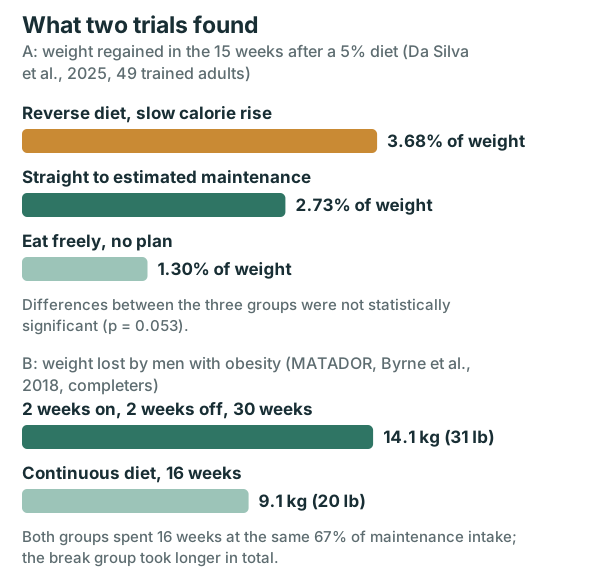
Two limits matter. The trial was small, and its participants were trained lifters, who differ from most dieters. Treat the result as "no evidence of benefit so far", which is weaker than proof that reverse dieting fails.
Does reverse dieting boost metabolism?
The claim that reverse dieting boosts metabolism has no direct evidence, and there is a simpler explanation for what people notice. Resting metabolic adaptation shrinks when you stop losing weight, whatever route you take to maintenance. In Martins and colleagues' study, it fell from 92 to 38 calories a day after just four weeks of eating to hold weight steady (American Journal of Clinical Nutrition, 2020).
So when someone reverse diets and feels their metabolism "recover", reaching energy balance is doing the work, and the slow ramp is optional. Our page on metabolic adaptation has the full set of numbers.
Diet breaks: the better-tested cousin
A diet break means pausing a diet at maintenance calories for one or more weeks, then resuming. Unlike reverse dieting, diet breaks have been tested in several randomised trials, with results that depend on who was studied.
| Trial | Who | Design | Result |
|---|---|---|---|
| MATADOR (Byrne et al., 2018) | Men with obesity | 2 weeks dieting, 2 weeks maintenance, repeated; 16 diet weeks over 30 | 14.1 vs 9.1 kg lost; less resting adaptation with breaks |
| ICECAP (Peos et al., 2021) | 61 resistance-trained adults | 3 weeks dieting, 1 week maintenance; vs 12 weeks continuous | No difference in fat loss or muscle; less hunger with breaks |
| Johnson et al., 2026 | 30 women with obesity | Refeeds and planned breaks vs continuous 25% deficit, 12 weeks | Fat loss 9.21 vs 9.30 kg: no meaningful difference |
| Poon et al., 2025 meta-analysis | 12 trials, 881 people | Breaks vs continuous restriction | Same body composition change; smaller drop in resting metabolism with breaks, more so in people with overweight |
In the 2026 trial the continuous group achieved a bigger daily deficit (1,005 vs 690 calories), yet lost the same fat.
Our reading: diet breaks do not speed up fat loss in most trials, but they cost nothing in fat loss, may limit the drop in resting metabolism, and lowered hunger in ICECAP. For anyone who struggles to stick with a long diet, those are good reasons to plan them in.

Maintenance is a skill worth practising
Picture a few weeks where the goal is simply to hold your weight: full meals, steady training, no countdown. A planned break turns maintenance from a cliff edge into something you have already practised.
That rehearsal may matter more than any calorie formula, because keeping weight off is where most diets fail.
What about refeed days?
Refeed days, one or two higher-carbohydrate days a week within a diet, have much less evidence of their own. The 2026 trial in women with obesity combined refeeds with planned breaks and found the same fat loss as continuous dieting. We found no trial that isolates the effect of refeed days in the general population. A refeed will raise the scale the next morning, because glycogen is stored with water.
How to finish a diet, based on the evidence
The best-supported way to finish a diet is to reach your new maintenance intake and hold it, by whichever route you will actually stick to. Estimate maintenance at your current weight with the NIH Body Weight Planner, expect the scale to rise a little as glycogen refills, and judge regain on a four-week average. If a gradual ramp makes the transition feel safer, the trial found no significant difference from the alternatives; just do not expect it to change your metabolism.
Reverse dieting questions
Can you lose weight by reverse dieting?
Reverse dieting is designed for the end of a diet, not for losing weight, since calories rise toward maintenance. In the 2025 trial, all three post-diet groups including the reverse dieters regained some weight.
How long should a reverse diet last?
There is no evidence-based length for a reverse diet. In the one trial, the ramp ran inside a 15-week post-diet period, with calories rising weekly until maintenance. Going straight to estimated maintenance produced similar results.
What is the difference between a diet break and reverse dieting?
A diet break is a pause at maintenance in the middle of a diet, after which dieting resumes. Reverse dieting is a slow climb to maintenance at the end of a diet. Diet breaks have several randomised trials behind them; we found one for reverse dieting.
Do diet breaks reduce metabolic adaptation?
Diet breaks appear to reduce the drop in resting metabolism. A meta-analysis of 12 trials found a smaller reduction with breaks than with continuous dieting, especially in people with overweight or obesity (Poon et al., 2025).
Will a refeed day ruin my progress?
A planned refeed day will not undo weeks of fat loss, though the scale may jump by a pound or two the next day as glycogen and water refill. In the 2026 trial, a plan with refeeds and breaks lost as much fat as continuous dieting.
Sources
We read the abstract of every trial and of the meta-analysis listed here. The 2025 reverse dieting trial is listed in PubMed Central.
- Da Silva V, et al. The effects of reverse dieting on mitigating weight regain after a caloric deficit: a preliminary analysis. J Int Soc Sports Nutr. 2025. PMC12381988
- Martins C, et al. Metabolic adaptation is an illusion, only present when participants are in negative energy balance. Am J Clin Nutr. 2020;112:1212-8. PubMed 32844188
- Byrne NM, et al. Intermittent energy restriction improves weight loss efficiency in obese men: the MATADOR study. Int J Obes. 2018;42:129-38. PubMed 28925405
- Peos JJ, Helms ER, Fournier PA, et al. Continuous versus intermittent dieting for fat loss and fat-free mass retention in resistance-trained adults: the ICECAP trial. Med Sci Sports Exerc. 2021;53:1685-98. PubMed 33587549
- Johnson KE, Curran B, Roberson S, et al. The effects of continuous vs. intermittent caloric restriction on fat loss: a randomized controlled trial. Nutrients. 2026;18(11):1823. PubMed 42280466
- Poon ET, Tsang JH, Sun F, et al. Effects of intermittent dieting with break periods on body composition and metabolic adaptation: a systematic review and meta-analysis. Nutr Rev. 2025;83:59-71. PubMed 38193357
- NIDDK. Body Weight Planner. niddk.nih.gov/bwp
Keep reading

Metabolism
Metabolic adaptation
How much your metabolism slows after weight loss, study by study, and why starvation mode is a myth.

Plateaus
Weight loss plateaus
Why every fixed diet stops working, how to check whether yours has, and what to change first.

Set point
Set point theory
Does the body defend one weight? The evidence for and against, and the models that replaced it.